Nixonized counterfeit U.S. currency
Inherent ViceNixonized counterfeit U.S. currency consists of forged American bills bearing Richard Nixon’s face, found in shipping containers recovered from the ocean. Their unexplained appearance links a suspected international currency shipment to the Golden Fang, recalls the CIA’s use of forged North Vietnamese money, and gives Doc a striking visual puzzle when he recognizes the same expression on Nixon during a televised rally. The bills remain suspended between counterfeit money, possible circulating currency, and political symbol: their value is uncertain, but their image makes them difficult to treat as ordinary cash.
Discovery and Physical Appearance
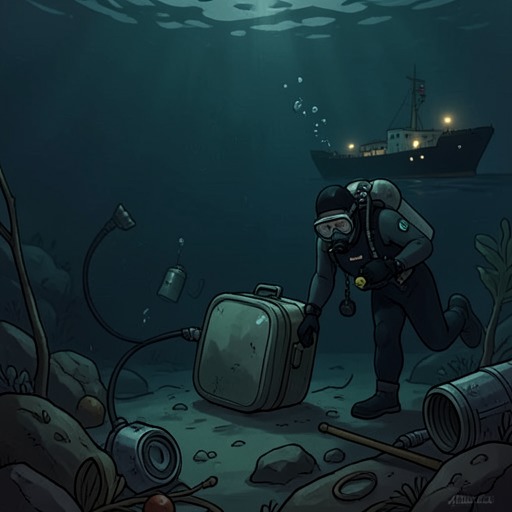
The bills emerge during a federal investigation at a site previously identified as a possible place where the Golden Fang had left a lagan. Sauncho has spent the day and night aboard a Justice Department vessel with federal agents; divers search the ocean as the light changes and bring up one shipping container after another, each packed with shrink-wrapped U.S. currency. The find may be the same shipment that Cookie and Joaquin had been trying, with diminishing conviction, to locate on behalf of Blondie-san.
Opening the containers turns a recovery operation into an absurd discovery. Whatever the denomination, the bills bear Nixon’s face instead of the familiar portraits of Washington, Lincoln, Franklin, and other figures. The agents briefly consider whether the entire task force might be hallucinating. That doubt is less a resolution than an effect of the money itself: the bills look like currency, yet their impossible portrait makes the recovered cargo seem to belong to a reality slightly out of joint.
The portrait is not merely an altered likeness. Nixon’s eyes appear unfocused, and his expression seems almost to recoil from something beyond the edge of the engraved frame. When Doc later compares a bill with Nixon on television, he finds the same startled expression in both. The image therefore serves as a peculiar link between a mass-produced counterfeit and a particular moment of Nixon’s public appearance.
Earlier Currency Operations and Competing Explanations
Sauncho’s intelligence contacts describe a precedent: the CIA had reportedly put Nixon’s face on counterfeit North Vietnamese bills and dropped millions of them over North Vietnam during routine bombing raids, in an effort to destabilize enemy currency. That account establishes that Nixon’s image had already been used in a scheme to make money itself an instrument of political disruption. It does not, however, explain why the face would appear on forged U.S. bills recovered at sea.
The new currency prompts competing explanations rather than a settled account. Some suspect Chinese Communist pranksters, reasoning that the engraving is too skillful to be anything but a deliberate foreign intervention. Others suggest that the bills may have circulated as scrip in Southeast Asia and might even be negotiable in the United States. The possibility that someone could spend them sits uneasily beside the agents’ immediate suspicion that they are worthless. Their practical and symbolic status remains unresolved.
A further possibility arises from the odd geography of the discovery. Cookie and Joaquin’s earlier search concerned containers of U.S. currency believed to be moving through international waters toward Hong Kong; the ocean recovery may involve that same cargo, but the connection is presented as a possibility rather than confirmed identity. The sequence makes the bills part of a broader network of shipping, covert operations, and hard-to-verify information, without demonstrating who made this particular batch or what its intended use was.
The Portrait and Its Political Joke
Sauncho points out that the law requires a person to be dead before their portrait can appear on U.S. currency. From that rule he draws a darkly comic inference: if Nixonized money were legal tender in any universe, Nixon would have to be dead. He imagines the bills as sympathetic magic, made by someone hoping to see Nixon among the departed. This is Sauncho’s speculation, not a confirmed explanation of the counterfeit’s origin or purpose; its force comes from the collision between a technical currency rule and the portrait of a living president.
The same incongruity gives the bills a value beyond their uncertain purchasing power. One observer raises the collectors’ market as another possible source of worth, while others doubt the money altogether. Sauncho, by contrast, says he has already spent one of the Nixon twenties on distinctive white loafers on Hollywood Boulevard without anyone examining the bill. The anecdote shows that at least one note can pass unnoticed in an ordinary transaction, even as its unusual design invites suspicion and fascination.
Doc’s Recognition and the Unsettled Meaning
Later, at Penny’s apartment, Doc wakes in front of a television showing Nixon addressing a rally. The image on the screen strikes him as identical to the face on the counterfeit twenty-dollar bill he received from Sauncho. He takes the bill from his wallet and compares the two; the resemblance is not an impression he leaves untested but a likeness he deliberately checks.
Doc’s recognition changes the problem from one of forged money to one of chronology. The image on the counterfeit bills had already circulated months before the televised Nixon image Doc now sees. He tries to account for that sequence through a speculative chain involving a CIA engraver copying the image from a screen and information somehow traveling backward in time, with a covert mailbox and even insurance against messages lost among unknown energy surges. The thought is a drug-influenced conjecture, not evidence that time travel has occurred or that the CIA created these U.S. bills. Its extravagant mechanics register Doc’s effort to impose a causal explanation on a coincidence that seems to reverse the ordinary direction between image and copy.
The currency thus remains both materially available and epistemically unstable. A bill can be recovered from a container, examined against a television image, and apparently spent; none of those acts establishes who produced it, whether it was intended to circulate, or why its portrait anticipates the expression Doc sees later. Nixon’s face turns money into a carrier of political meaning, while the unresolved timing makes the bills an emblem of the novel’s larger traffic among covert power, circulating value, and uncertain knowledge.